Top 10 AI Tools Everyone Is Using in 2026: The Agentic Revolution
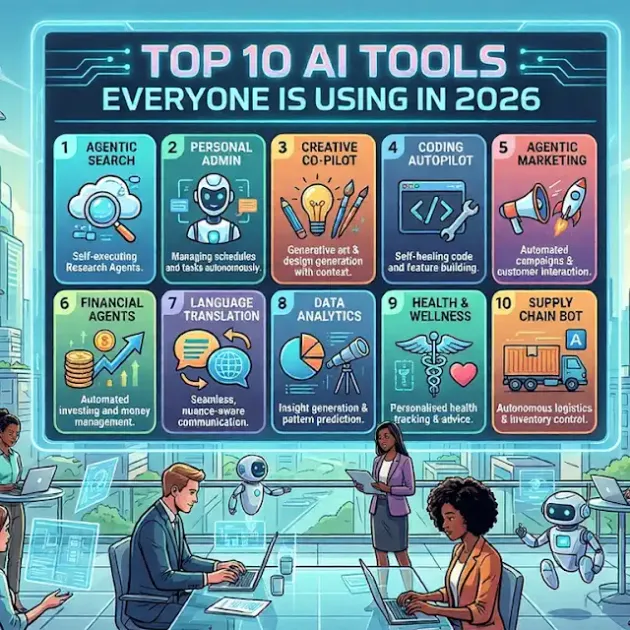
The Shift from Assistance to Autonomy
As we navigate 2026, the AI landscape has matured beyond simple chatbots and image generators. We have officially entered the era of Agentic AI—systems that don't just suggest code or write emails, but actively execute complex workflows, manage infrastructure, and iterate on product designs with minimal human intervention.
For software developers and startups, staying ahead means mastering these tools to multiply output by factors of 10x or even 100x. Here are the top 10 AI tools dominating the ecosystem in 2026.
1. Cursor Ultra: The Neural IDE
By 2026, Cursor has evolved from a VS Code fork into a fully neural-integrated development environment. It doesn't just autocomplete; it predicts the next three files you need to create based on your PR description.
- Key Feature: 'Shadow Coding'—the IDE simulates potential bugs in the background as you type.
- Best For: Rapid full-stack prototyping.
2. Devin 2.0: The Autonomous Software Engineer
Cognition's Devin remains the gold standard for autonomous agents. In 2026, Devin 2.0 can join your Slack, pick up a Jira ticket, write the code, pass the CI/CD pipeline, and deploy to staging without a single manual prompt.
- Impact: Startups are now hiring Devin instances for maintenance tasks while humans focus on architecture.
3. Vercel v0: Generative UI at Scale
What started as a prompt-to-UI experiment is now the primary way front-end development begins. v0 now generates high-fidelity, accessible, and performant React components that are directly synced with Figma designs.
- Key Tech: Integration with Tailwind CSS 5 and React 20.
4. LangGraph & LangSmith: The LLMOps Backbone
As companies move toward multi-agent systems, LangGraph (by LangChain) has become the essential framework for orchestrating cyclical AI workflows. LangSmith provides the observability needed to debug why an agent went off the rails.
- Use Case: Building complex customer support agents that can access SQL databases and external APIs.
5. Pinecone Serverless: High-Precision RAG
Vector databases are the memory of AI. Pinecone’s 2026 serverless architecture allows for trillion-scale vector searches with sub-10ms latency, making Retrieval-Augmented Generation (RAG) faster than standard database queries.
- Why it matters: Essential for real-time personalization in SaaS apps.
6. Tavily: The AI-Native Search Engine
Google is for humans; Tavily is for LLMs. This search engine is optimized for high-context, factual data retrieval, allowing AI agents to conduct market research or technical documentation scrapes without the 'noise' of traditional SEO.
7. Llama 4 (Quantized for Edge)
Meta's Llama 4 has democratized high-tier intelligence. The 'Small' 15B parameter model now runs natively on mobile devices and Macbooks with GPT-5 level reasoning, enabling 'Privacy-First' AI startups.
8. Runway Gen-4: Narrative Marketing AI
Marketing for startups has been disrupted by Runway. Gen-4 produces hyper-realistic 8K product trailers and social media content from a simple script, eliminating the need for expensive video production for early-stage companies.
9. Weights & Biases (W&B) Prompts
W&B has pivoted from just ML experimentation to Prompt Engineering & Evaluation. It is the industry standard for version-controlling prompts and testing LLM outputs against regression suites.
10. Mistral Large 3: The Enterprise Powerhouse
For European startups and privacy-conscious enterprises, Mistral Large 3 offers a compelling alternative to OpenAI. Its modular architecture allows for incredibly cheap fine-tuning on proprietary datasets.
Conclusion: The New Developer Stack
In 2026, being a 'Senior Developer' is less about syntax and more about Agent Orchestration. The tools listed above represent a paradigm shift where the AI is the executor, and the human is the architect. To stay relevant, startups must integrate these tools into their DNA, focusing on speed, scalability, and the unique value that only human intuition can provide.
Are you ready to automate the mundane and build the impossible?