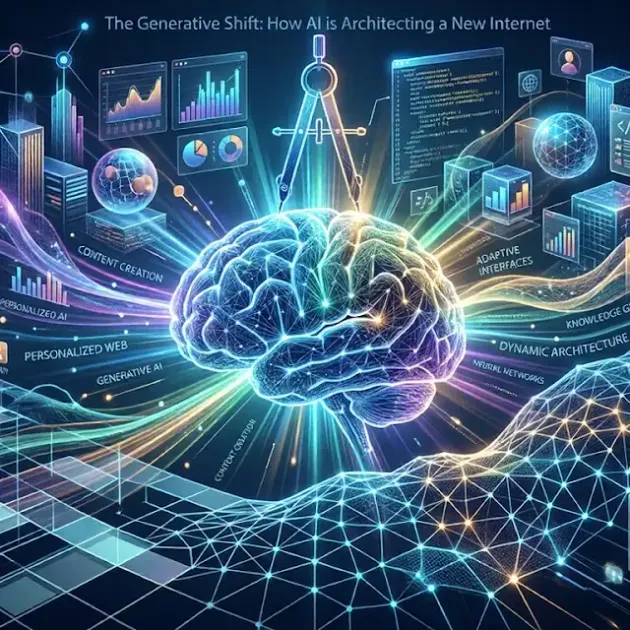
The Generative Shift: How AI is Architecting a New Internet
Introduction: Beyond the Hype
The internet is currently undergoing its most significant structural shift since the transition from desktop to mobile. Generative AI (GenAI) is not merely a new tool in the developer’s kit; it is rewriting the fundamental laws of content creation, information retrieval, and user interaction. For software developers, startups, and tech enthusiasts, understanding this paradigm shift is no longer optional—it is a survival requirement.
1. From Search Engines to Answer Engines
For decades, the internet functioned as a massive index. Users provided keywords, and Google provided a list of blue links. This is the Retrieval Era. We are now entering the Synthesis Era.
The Rise of Generative Engine Optimization (GEO)
With the advent of Perplexity, ChatGPT (SearchGPT), and Gemini, users are increasingly bypassing traditional search results for direct, synthesized answers. This poses a challenge for technical content creators:
- Semantic Relevance over Keyword Stuffing: LLMs prioritize context and authority over simple keyword density.
- The End of 'Filler' Content: AI can generate generic content instantly, making high-value, unique, and deeply technical insights the only way to remain relevant.
2. Software Development: Code as a Commodity
Generative AI has fundamentally changed the SDLC (Software Development Life Cycle). Tools like GitHub Copilot and Cursor have turned coding from a syntax-heavy exercise into an architectural challenge.
- The Rise of the 'Architect Developer': As AI handles boilerplate code, unit tests, and routine refactoring, the developer’s role shifts toward system design, security auditing, and complex logic orchestration.
- Agentic Workflows: We are moving from simple code completion to autonomous agents capable of fixing bugs, managing CI/CD pipelines, and even writing documentation based on PR comments.
3. The New Web Stack: LLM-First Architecture
The modern tech stack is evolving. We are seeing the emergence of the 'AI-Native' stack, which includes:
- Vector Databases: Tools like Pinecone, Milvus, and Weaviate are now as critical as relational databases for RAG (Retrieval-Augmented Generation).
- Orchestration Layers: Frameworks like LangChain and LlamaIndex allow developers to connect LLMs to their private data securely.
- The Edge AI: Moving inference to the browser (using WebGPU and WASM) to reduce latency and improve privacy.
4. The Content Paradox and Provenance
As the internet becomes flooded with synthetic media, the value of 'Proof of Human' content increases. This is leading to:
- Digital Watermarking: New standards like C2PA are becoming essential to verify the origin of images, videos, and text.
- The Authenticity Premium: Startups that can prove the human expertise behind their data will command higher trust and valuation.
Conclusion: The Path Forward
Generative AI is not 'killing' the internet; it is clearing the clutter of the old one to make room for a more personalized, efficient, and intelligent web. For developers and startups, the opportunity lies in building the 'connective tissue' between these powerful models and real-world utility. The future belongs to those who view AI not as a replacement, but as the ultimate force multiplier.