Beyond the Hype: How AI is Re-Architecting the Internet's DNA
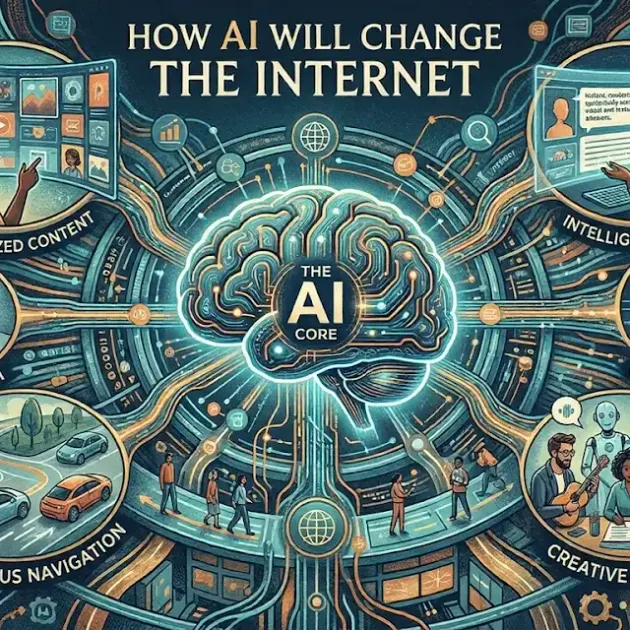
Beyond the Hype: How AI is Re-Architecting the Internet's DNA
The internet is undergoing its most significant architectural shift since the transition from static web pages (Web 1.0) to social, user-generated platforms (Web 2.0). We are no longer just looking at a technological upgrade; we are witnessing a fundamental re-engineering of how data is consumed, indexed, and generated.
For developers, startups, and tech enthusiasts, understanding this shift is the difference between building for the past and leading the future.
1. The Death of the Link-Based Economy
For decades, the internet has functioned as a library of links. Google’s PageRank algorithm was the librarian. However, the rise of Search Generative Experience (SGE) and LLM-based interfaces (Perplexity, ChatGPT) is shifting the paradigm from search to answer.
- Zero-Click Reality: Users no longer need to visit websites to find information. AI summarizes the content directly in the UI.
- The SEO Pivot: Traditional SEO is evolving into AIO (AI Optimization). Content must be structured not just for crawlers, but for LLM context windows and RAG (Retrieval-Augmented Generation) systems.
2. The Rise of the 'Agentic' Web
We are moving away from passive browsing toward an Agentic Web. Instead of humans navigating websites, autonomous AI agents will interact with APIs and headless browsers on behalf of the user.
Technical Implications for Developers:
- API-First is Mandatory: If your service isn't accessible via a clean, well-documented API, AI agents won't be able to use it, effectively making your business invisible to the new web.
- Standardization: We may see a return to strict schema requirements (JSON-LD, Microdata) to ensure agents can parse intent accurately.
3. Generative UI and Hyper-Personalization
In the near future, the UI of a website might not be hard-coded. Using Generative UI, front-ends will be assembled in real-time based on the user's specific context, accessibility needs, and technical proficiency.
- The End of One-Size-Fits-All: A senior developer might see a dashboard full of CLI-style metrics, while a business executive sees high-level visualizations—both generated from the same data stream.
- Latency Challenges: The bottleneck shifts from asset loading to inference latency. Edge computing and optimized model weights (Quantization) will become critical skills for front-end engineers.
4. The Content Paradox: Synthetic vs. Authentic
AI is lowering the cost of content production to near zero. This creates a "content flood" problem.
- Proof of Personhood: Technologies like Worldcoin or cryptographic signing (Content Credentials) will become standard to distinguish human-created content from synthetic media.
- Data Sovereignty: Startups will increasingly focus on proprietary datasets. When everyone has access to the same LLMs, the only competitive advantage is the quality and uniqueness of your training data.
5. Security in the Age of Adversarial AI
Cybersecurity is evolving from signature-based detection to behavioral AI analysis.
- Phishing 2.0: AI can generate personalized, perfect social engineering attacks at scale.
- Zero-Trust Architecture: Developers must adopt stricter zero-trust models. If AI can simulate a user's voice, image, and typing cadence, traditional multi-factor authentication (MFA) must evolve toward biometric hardware keys.
Conclusion
The AI-driven internet is not a distant future; it is being built in real-time. For developers, the goal is no longer just to build "apps," but to build intelligent ecosystems that are agent-readable, API-centric, and privacy-first. The internet is becoming an active assistant rather than a passive resource.
The question is: Are you building the tools for this new era, or are you still optimizing for the librarian?