The New Internet Architecture Built for AI: The Future Beyond the Hypertext Era
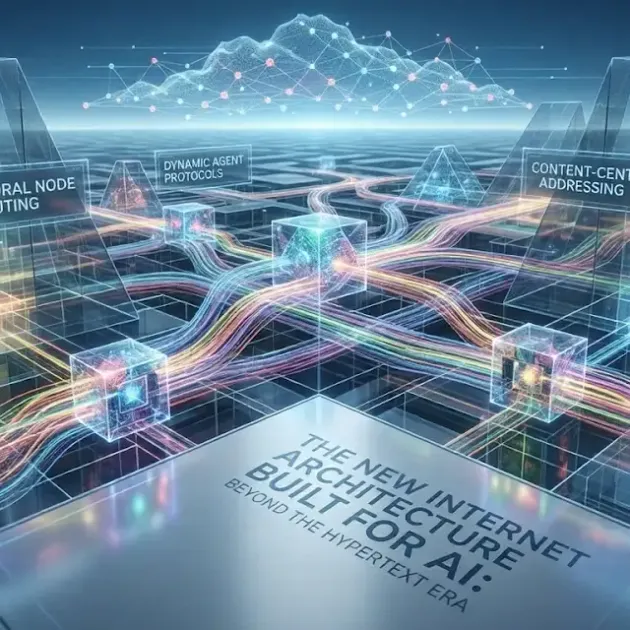
The New Internet Architecture Built for AI: The Future Beyond the Hypertext Era
For more than three decades, the internet has been built around a model designed primarily for content delivery. From early static HTML pages to modern video streaming platforms, the primary goal of internet infrastructure was to move data from centralized servers to end users.
However, the rapid rise of Artificial Intelligence, Large Language Models (LLMs), and generative AI systems is fundamentally changing this architecture.
We are transitioning from an internet built for data distribution to an internet designed for AI inference and intelligent computation.
This shift requires a complete rethinking of how networks, computing infrastructure, storage systems, and security models work together.
1. From TCP/IP to Compute-Centric Networking
Traditional web architecture relies on a simple request–response model built on protocols such as TCP/IP and HTTP.
While this model works well for websites and APIs, it is inefficient for modern AI workloads that require massive computational power and real-time data processing.
AI systems often rely on thousands of GPUs working together, which introduces new networking challenges.
RDMA and InfiniBand for High-Performance AI
Inside modern AI data centers, traditional Ethernet networking is increasingly being replaced by high-performance interconnect technologies such as:
- RDMA (Remote Direct Memory Access)
- InfiniBand networking
These technologies allow GPUs to communicate directly with each other without routing data through the CPU, dramatically reducing latency.
This enables the massive parallel processing required for training large AI models and performing high-speed inference.
2. The Rise of Edge AI and Distributed Inference
Another major shift in internet architecture is the movement away from centralized mega-data centers toward distributed edge computing environments.
Edge Inference
Edge AI allows machine learning models to run closer to the user rather than relying entirely on cloud infrastructure.
Benefits of edge inference include:
- Reduced latency for real-time applications
- Improved privacy by keeping data on-device
- Lower bandwidth usage
Many modern devices now include specialized AI processors such as NPUs (Neural Processing Units) capable of running smaller models locally.
From CDNs to Inference Delivery Networks
Traditional Content Delivery Networks (CDNs) were designed to cache static assets such as images, videos, and scripts.
In the AI era, these networks are evolving into Inference Delivery Networks (IDNs).
Instead of caching static content, these networks can cache:
- AI model weights
- vector embeddings
- inference pipelines
This allows AI computations to run at edge locations close to users.
3. Vector Databases: The Memory Layer of the AI Internet
In the AI-native internet architecture, traditional databases are being complemented by vector databases.
Unlike relational databases that store structured rows and columns, vector databases store data as high-dimensional embeddings.
This architecture enables advanced AI capabilities such as:
- semantic search
- contextual information retrieval
- Retrieval-Augmented Generation (RAG)
Popular vector database platforms include:
- Pinecone
- Milvus
- Weaviate
These systems allow AI models to access large knowledge bases in real time, effectively serving as the long-term memory layer of AI applications.
4. The Networking Bottleneck: High-Bandwidth Infrastructure
As AI models grow to trillions of parameters, the network infrastructure connecting compute nodes becomes a critical bottleneck.
To support next-generation AI systems, infrastructure providers are investing heavily in:
Ultra-Low Latency Fiber Networks
Dedicated high-speed fiber connections allow data centers to operate as distributed supercomputers.
Advanced Cooling Systems
Next-generation GPUs often consume 1000W or more of power, generating enormous heat.
To support these chips, data centers are shifting from traditional air cooling to direct liquid cooling systems capable of handling extreme thermal loads.
5. Security in the AI-Native Internet
Security models must also evolve in response to AI-driven infrastructure.
One major trend is the integration of Zero Trust security models combined with verifiable computing.
Trusted Execution Environments (TEEs)
Trusted execution environments allow computations to run in secure hardware enclaves that cannot be tampered with by external actors.
This ensures that:
- AI computations remain secure
- model outputs are authentic
- man-in-the-middle attacks cannot manipulate results
This is especially important for applications involving financial systems, healthcare data, and critical infrastructure.
The Future: An Intelligent Digital Fabric
The internet is no longer just a network for transmitting information. It is evolving into a global computational fabric designed to power intelligent systems.
For developers, startups, and technology innovators, this shift opens massive opportunities to build tools and platforms that manage this new complexity.
Key areas of innovation include:
- GPU orchestration platforms
- AI model monitoring and optimization
- decentralized infrastructure networks (DePIN)
- AI-native cloud platforms
As the world moves toward agent-based AI systems and autonomous workflows, this new internet architecture will become the foundation of the next trillion-dollar technology ecosystem.
Conclusion
The next generation of the internet will not be defined by faster websites or larger data centers.
Instead, it will be defined by AI-native infrastructure capable of supporting massive computational workloads in real time.
From edge inference and vector databases to high-performance networking and verifiable compute, the internet is transforming into a living infrastructure of intelligence.
Organizations and developers that adapt to this new architecture early will be at the forefront of the AI-driven digital economy.
FAQ
What is AI-native internet architecture?
AI-native internet architecture refers to infrastructure designed specifically to support artificial intelligence workloads such as model training, inference, and distributed computation.
Why are vector databases important for AI?
Vector databases allow AI models to store and retrieve information using embeddings, enabling advanced features like semantic search and retrieval-augmented generation.
What is edge AI inference?
Edge AI inference refers to running AI models closer to the user on local devices or edge servers instead of centralized cloud data centers.
How will AI change internet infrastructure?
AI will transform internet infrastructure by requiring faster networks, specialized hardware, distributed computing systems, and new storage architectures optimized for machine learning workloads.