Before writing the first line of code... decide the rendering battle
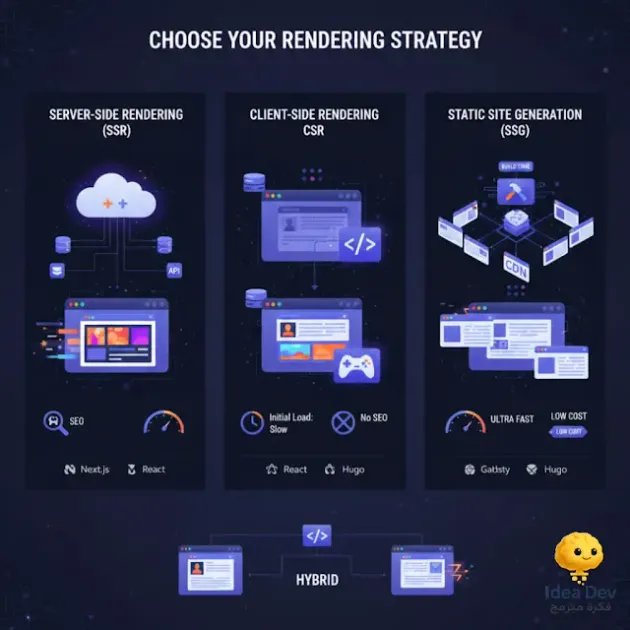
Many digital projects fail due to poor programming... Rather, it was due to an ill-considered architectural decision from the beginning. One of the most important of these decisions is: How will the pages be generated and displayed to the user? Is this done on the server? Or in the user's browser? Or are pages created in advance and stored ready?
Let us explain the matter in detail and in a clear and systematic manner 👇
☝️First: Server-Side Rendering (SSR)
What does it mean🤔? In this method, the entire page is generated within the server at each user request, and the finished HTML page is then sent to the browser.
How does the process work technically? 1 User requests the page. 2 The server receives the request. 3 Fetches data from the database or from a programming interface (API). 4 Generates the entire page in HTML format. 5 Sends it to the browser ready for display. 6 After rendering, JavaScript is enabled to add the interaction (Hydration).
Advantages: Content appears quickly on the first visit. Excellent for search engines (SEO), because the page arrives complete and ready to be indexed. Suitable for variable or personalized content for each user.
Disadvantages: Every request needs to be processed on the server, which increases pressure on it. It needs strong infrastructure when there is a large number of visitors. Response time depends on the speed of the server and database.
When is it used? Online stores, news sites, search results pages, Any project depends on visits from search engines.
One of the most famous frameworks that support this method is Next.js
✌️ Second: Client-Side Rendering (CSR)
What does it mean🤔? In this approach, the server sends a very simple page, and then the browser loads JavaScript files that build the entire page inside the user's device.
How does the process work technically? 1 User requests the page. 2 The server sends a simple HTML file. 3 The browser loads JavaScript files. 4 JavaScript fetches data from API. 5 Page content is built within the browser.
Advantages: Highly interactive and fast experience after the first download. Reduces pressure on the server. Ideal for Web Applications.
Disadvantages: The first load may be slower due to the size of the JavaScript files. Less efficient in terms of SEO, because the content is not located directly in the raw HTML.
When is it used? Dashboards. SaaS applications. Platforms that rely on continuous interaction.
The most famous library that supports this approach: React Well-known example: Gmail
👌 Third: Static Site Generation (SSG)
What does it mean🤔? In this approach, all pages are created at once during the Build Time phase, then stored as static HTML files and served directly from the CDN.
How does the process work technically? During the build process, data is fetched. Entire pages are created in HTML format. The files are uploaded to the CDN. When the user requests, he gets the ready page immediately without any further processing.
Advantages: Fastest performance possible, excellent for search engines, very low running cost, high scalability.
Disadvantages: Not suitable for content that is constantly changing. In large projects, the construction process may take a long time.
When is it used? Blogs, corporate websites, static pages, documentation sites. Famous tools: Gatsby, Hugo
👏 Conclusion If your project depends on traffic from search engines and variable content → choose SSR If you are building an interactive web application for registered users → choose CSR If your site is static and you are looking for maximum speed and lowest cost → choose SSG The most professional solution today is to combine these methods within the same project according to the nature of each page. Choosing a rendering method is not only a technical decision... Rather, it is a decision that affects performance, cost, user experience, and long-term project growth.
#idea_programmer #idea2dev