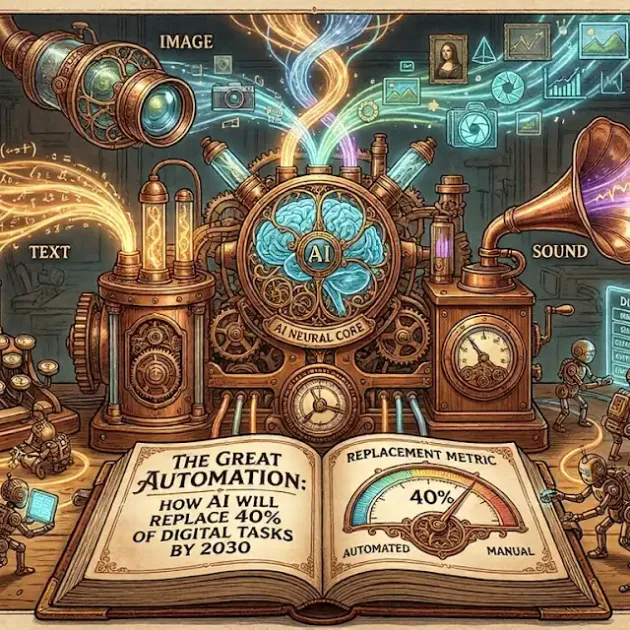
The Great Automation: How AI Will Replace 40% of Digital Tasks by 2030
Introduction: The Paradigm Shift in Digital Labor
By 2030, the digital landscape will be unrecognizable. Leading research from firms like Gartner and McKinsey suggests that approximately 40% of current digital tasks—ranging from routine data entry to complex software debugging—will be fully automated or significantly augmented by Artificial Intelligence. For software developers, startups, and tech enthusiasts, this isn't just a trend; it's a fundamental restructuring of the global workforce.
This article explores the technical mechanisms driving this shift, the sectors most affected, and how professionals can pivot to remain indispensable in an AI-first economy.
1. From Co-pilots to Autonomous Agents
We are currently in the era of 'Assistive AI' (e.g., GitHub Copilot, ChatGPT). However, the transition toward Autonomous Agents is already underway. Unlike current LLMs that require step-by-step prompting, autonomous agents (powered by frameworks like LangChain and AutoGPT) can:
- Decompose high-level goals into actionable sub-tasks.
- Execute code in sandbox environments.
- Self-correct errors without human intervention.
By 2030, these agents will handle the bulk of 'middle-ware' digital work, such as API integrations, legacy code migration, and cross-platform testing.
2. Impact on Software Development and DevOps
Software engineering is at the epicenter of this disruption. While AI won't replace the architect, it will certainly replace the coder of repetitive boilerplate.
Automated Code Lifecycle
- Refactoring & Technical Debt: AI models will continuously scan repositories to optimize performance and automatically refactor outdated syntax.
- CI/CD Optimization: Predictive AI will identify potential deployment bottlenecks before they occur, managing infrastructure as code (IaC) with 99.9% precision.
- Testing: Unit tests and integration tests will be generated dynamically based on user behavior patterns rather than static scripts.
3. Data Science and Decision Intelligence
In the startup ecosystem, the 'Data Analyst' role is evolving. AI-driven Decision Intelligence platforms can now process unstructured data at a scale impossible for humans. By 2030, 40% of data preparation and cleaning—tasks that currently consume 80% of a data scientist's time—will be handled by autonomous pipelines.
4. The Rise of 'Prompt Engineering' to 'System Design'
As low-level tasks vanish, the value of a developer moves up the stack. The focus shifts from how to write code to how to architect systems.
Essential Skills for the 2030 Landscape:
- AI Orchestration: Managing multiple AI models to work in a unified pipeline.
- Ethics & Governance: Ensuring AI outputs are unbiased and secure.
- Human-in-the-Loop (HITL) Design: Building interfaces where humans provide high-level strategic oversight.
Conclusion: Adapting to the New Reality
The 40% displacement of digital tasks is not a harbinger of unemployment, but an invitation to higher-level innovation. Startups that embrace AI-native workflows today will outpace those clinging to manual processes. For the individual developer, the goal is clear: stop being a tool user and start being a system architect.
The future belongs to those who build the automation, not those who are replaced by it.