Beyond the Grid: Building the Future of Smart Cities with AI
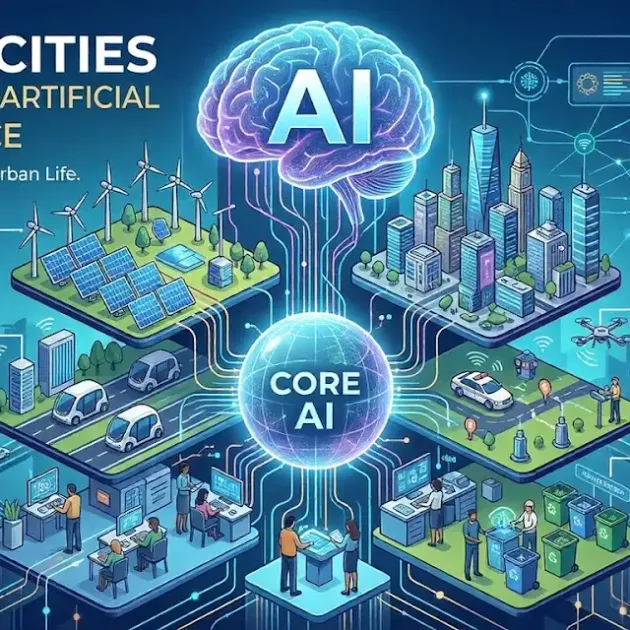
Beyond the Grid: Building the Future of Smart Cities with AI
As urban populations approach 6.7 billion by 2050, traditional infrastructure is under unprecedented strain. For software developers, startups, and tech innovators, this represents a massive opportunity: the creation of AI-powered Smart Cities. By embedding Artificial Intelligence (AI) into urban infrastructure, cities can evolve from basic automation to predictive, self-healing ecosystems.
The Architectural Backbone of AI-Driven Cities
A Smart City functions as a massive, distributed data-processing engine. The technical architecture typically consists of four layers:
- Perception Layer (IoT): Millions of sensors—including LiDAR, acoustic, and environmental devices—collect real-time telemetry.
- Transmission Layer: High-speed, low-latency connectivity (5G/6G, LoRaWAN) ensures that data flows efficiently to compute nodes.
- Intelligence Layer (AI/ML): AI models, including Large Language Models (LLMs) for governance and Computer Vision for traffic management, process data and generate insights.
- Action Layer: Actuators, smart grids, and autonomous systems execute decisions derived from AI outputs.
Key Use Cases for Developers and Startups
1. Adaptive Traffic Management (Computer Vision & Edge AI)
Traffic congestion costs billions annually in lost productivity. Edge AI solutions using YOLO (You Only Look Once) or EfficientDet models can analyze traffic flows in real time. By dynamically adjusting traffic signals, AI can reduce idle times by up to 40%, improving urban mobility.
2. Smart Energy Grids (Predictive Analytics)
AI-driven predictive analytics using Recurrent Neural Networks (RNNs) and LSTMs allow startups to forecast peak energy demand. By balancing decentralized renewable sources, AI optimizes grid stability, reduces carbon emissions, and cuts operational costs.
3. Public Safety and Predictive Policing
Using Anomalous Event Detection, AI can identify emergency events—like breaking glass, gunshots, or erratic driving—before human operators respond. Developers face the challenge of maintaining data privacy and ethical AI usage while providing real-time public safety solutions.
The Developer’s Challenge: Scalability and Interoperability
Building AI for a city introduces unique constraints compared to traditional applications:
- Interoperability: Systems must integrate with legacy infrastructure using protocols such as MQTT or CoAP.
- Low Latency: Safety-critical applications cannot wait for cloud round-trips, necessitating Edge Computing and federated learning.
- Security: A smart city represents a massive attack surface. Zero Trust Architecture and hardware-level encryption are essential.
The Role of Digital Twins
Digital Twins are virtual replicas of urban infrastructure, providing high-fidelity simulation environments. Before deploying AI models controlling water, traffic, or energy systems, developers can test solutions in 3D environments powered by Unreal Engine 5 or NVIDIA Omniverse. This approach ensures safer, more reliable city operations.
Conclusion
AI-powered smart cities offer unprecedented opportunities for innovation. From autonomous shuttles to decentralized waste management systems, the goal is to create efficient, sustainable, and livable urban experiences.
For developers and startups, the AI solutions we build today will define the cities of tomorrow. By focusing on Edge AI, digital twins, predictive analytics, and robust cybersecurity, we can architect urban ecosystems that are intelligent, resilient, and human-centered.
FAQ
Q1: What is a Smart City? A Smart City integrates AI, IoT, and digital infrastructure to optimize urban services, improve quality of life, and reduce operational costs.
Q2: Why are Edge AI and low-latency networks important? Critical urban systems require real-time decision-making. Edge AI ensures instantaneous processing, while low-latency networks prevent delays that could compromise safety.
Q3: What is a Digital Twin? A Digital Twin is a virtual replica of a city or infrastructure system used to simulate, test, and optimize AI-driven operations before deployment.