AI vs Human Programmers: Who Wins the Battle for the Future of Code?
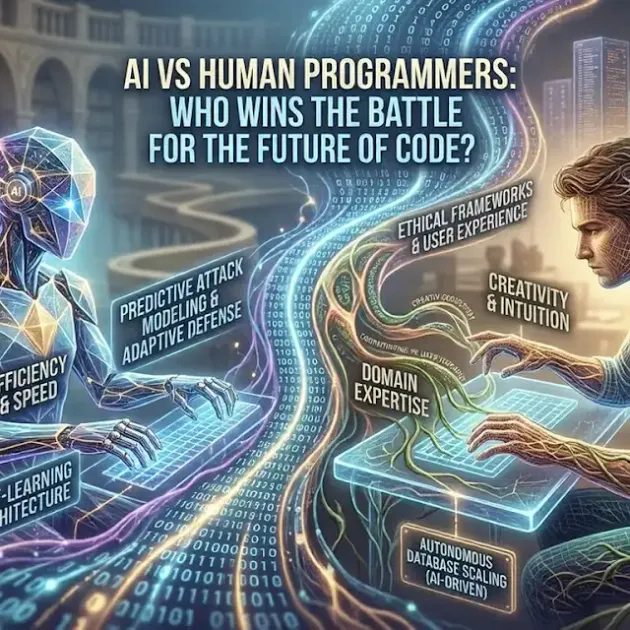
The Great Paradigm Shift in Software Engineering
For decades, programming was seen as an exclusively human endeavor—a blend of logic, mathematics, and creative problem-solving. However, the emergence of Large Language Models (LLMs) like GPT-4, Claude 3.5 Sonnet, and GitHub Copilot has sparked a heated debate: Is the era of the human programmer coming to an end?
This isn't just about syntax anymore. It’s about systemic efficiency, architectural integrity, and the evolution of the 'Developer' identity. To understand who 'wins,' we must dissect the strengths and limitations of both sides.
1. Where AI Dominates: Speed, Scale, and Syntax
AI doesn't get tired, it doesn't suffer from 'syntax fatigue,' and it has read every public repository on GitHub. Its strengths are undeniable:
- Boilerplate Elimination: AI can generate CRUD operations, API endpoints, and configuration files in milliseconds. What took a human 30 minutes now takes 3 seconds.
- Instant Debugging: Tools like DeepSeek or Claude can identify logical fallacies or missing null checks in legacy codebases far faster than a manual walkthrough.
- Learning New Frameworks: Need to switch from React to Svelte? AI provides immediate context and idiomatic examples, flattening the learning curve significantly.
- Documentation and Testing: AI excels at writing unit tests and generating Javadoc or TSDoc comments, tasks that human developers historically find tedious.
2. The Human Edge: Architecture, Ethics, and Intuition
While AI is a master of the 'how,' it often struggles with the 'why.' This is where experienced software engineers remain irreplaceable:
- System Architecture and Design: AI can write a function, but it cannot yet design a scalable, resilient microservices architecture that accounts for specific business constraints and long-term technical debt.
- Domain Expertise: Understanding a specific industry—be it Fintech, Healthcare, or Aerospace—requires nuance. AI lacks the 'contextual intuition' to know when a specific business requirement should override a 'best practice' coding pattern.
- Security and Ethics: AI frequently hallucinates or suggests insecure code patterns (e.g., SQL injection vulnerabilities). Humans are the final gatekeepers of security and ethical implementation.
- Collaboration and Soft Skills: Software isn't built in a vacuum. It requires stakeholder management, empathy, and team leadership—traits that an LLM cannot replicate.
3. The Real Winner: The "Cyborg" Developer
The question of 'Who Wins?' is a false dichotomy. The winner isn't AI, nor is it the 'Purist' human programmer who refuses to use it.
The winner is the AI-Augmented Developer.
Data shows that developers using AI tools are 55% faster at completing tasks. By offloading the 'grunt work' to AI, humans are elevated to the role of Software Architects and Code Reviewers. We are moving from 'writing code' to 'orchestrating solutions.'
4. The Future Outlook: Will Junior Roles Disappear?
There is a legitimate concern regarding entry-level positions. If AI can write basic scripts, what happens to the Junior Dev?
The bar for entry is rising. Tomorrow's Junior Developers must become proficient in Prompt Engineering, Code Auditing, and System Integration much earlier in their careers. The focus is shifting from memorizing syntax to understanding logic and systems thinking.
Conclusion: The New Era of Creativity
AI is not the death of programming; it is the death of 'coding' as a mundane task. It is the most powerful leverage tool ever created for the human mind. As we move forward, the most successful developers will be those who view AI not as a competitor, but as a high-speed co-pilot that allows them to dream bigger and build faster.
The verdict? Humans win, provided they evolve.