The Ultimate Guide to the Best AI Tools for Developers in 2026
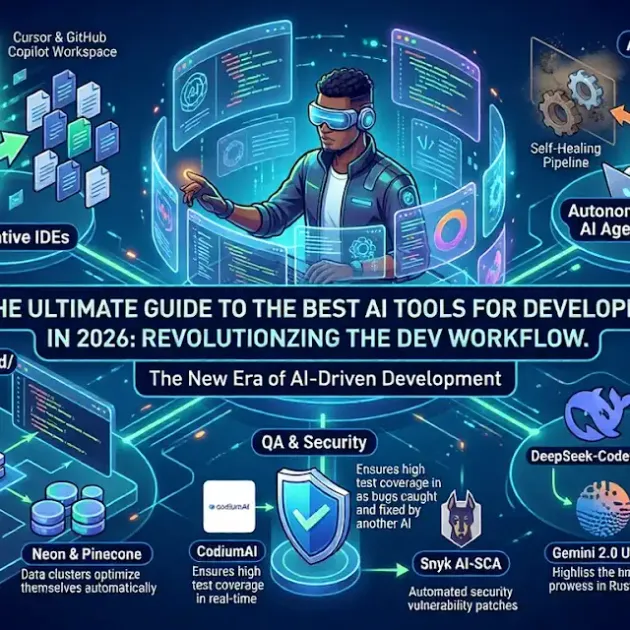
The Ultimate Guide to the Best AI Tools for Developers in 2026
By 2026, AI has become the backbone of software development. Developers no longer just write code—they orchestrate intelligence across the engineering lifecycle. This guide explores the most advanced AI tools for developers in 2026 and how they transform productivity, security, and scalability.
Table of Contents
- AI-Native IDEs
- Autonomous AI Coding Agents
- AI for DevOps & Infrastructure
- Next-Gen Testing & Security AI
- Specialized Coding Models
- AI-Enhanced Knowledge & Documentation Tools
- Collaboration & Planning AI
- Human-AI Collaboration Paradigm
- FAQ
- Conclusion
1. AI-Native IDEs
AI-Native IDEs now understand the full project context, offering repository-wide refactoring, code generation, and automated testing.
Cursor AI
- Repository-wide refactoring and complex migrations.
- Ideal for large-scale projects.
GitHub Copilot Workspace
- Converts natural language prompts into full feature implementations.
- Generates unit tests, PRs, and documentation automatically.
2. Autonomous AI Coding Agents
AI agents can manage tickets, self-heal pipelines, and reduce technical debt.
Devin & OpenDevin
- Monitor CI/CD pipelines and fix broken builds automatically.
- Refactor legacy code and deprecated APIs overnight.
SWE-Agent
- Open-source solution for secure, local deployments.
- Automates coding, ticket analysis, and merges.
3. AI for DevOps & Infrastructure
AI transforms DevOps from reactive to predictive and autonomous.
Vercel AI & Pulumi AI
- Generate Terraform/Pulumi scripts from natural language.
- Optimize serverless and edge architectures automatically.
Cloudflare AI
- Real-time optimization of caching, routing, and DDoS protection.
- Integrates with global edge servers.
4. Next-Gen Testing & Security AI
CodiumAI
- Detects logic gaps and generates tests automatically.
- Ensures high code coverage for new and legacy code.
Snyk AI-SCA
- Finds vulnerabilities and writes verified fixes.
- Context-aware analysis for runtime environments.
5. Specialized Coding Models
DeepSeek-Coder
- Optimized for Rust, Zig, and C++.
- High precision and semantic understanding.
Gemini 2.0 Ultra
- 2M+ token context window.
- Analyzes large monolithic codebases efficiently.
CodeGenX
- Real-time collaboration.
- Slack and VS Code integration for distributed teams.
6. AI-Enhanced Knowledge & Documentation Tools
Notion AI (Dev Pack)
- Auto-generate API docs from code.
- Docs evolve with code updates.
DocuGen
- Converts code into structured, readable, and search-friendly documentation.
7. Collaboration & Planning AI
JiraAI & LinearAI
- Generate tickets, prioritize backlogs, optimize sprints.
- Reduce planning overhead.
DesignGPT
- Converts UI/UX designs into working code automatically.
- Streamlines front-end workflows.
8. Human-AI Collaboration Paradigm
| Traditional Role | AI-Augmented Role 2026 |
|---|---|
| Manual coding | AI orchestration & prompt engineering |
| Debugging code | Validating AI outputs |
| Building features individually | Designing intelligent systems |
| Isolated problem-solving | Collaborative human-AI workflows |
Key Takeaway: Developers now focus on system architecture, strategic planning, and AI orchestration while AI handles repetitive coding, testing, and documentation.
FAQ
Q1: What are AI-native IDEs?
AI-native IDEs are integrated environments that understand project context, generate code, refactor repositories, and automate testing.
Q2: What is an autonomous AI coding agent?
These AI agents can independently handle tickets, monitor pipelines, and fix issues in codebases without human intervention.
Q3: How does AI improve DevOps?
AI predicts infrastructure needs, generates scripts, and optimizes serverless and edge architecture in real-time.
Q4: Are specialized coding models necessary?
Yes. Specialized models like DeepSeek-Coder and Gemini 2.0 Ultra provide high accuracy for niche languages and large codebases.
Q5: How can developers leverage AI in documentation?
Tools like Notion AI and DocuGen auto-generate structured documentation that evolves with the code, improving search indexing and knowledge sharing.
Conclusion
By 2026, Human-AI collaboration defines software development. Mastering AI-native IDEs, autonomous coding agents, and AI-enhanced DevOps tools allows developers to:
- Build faster and more scalable applications.
- Automate testing, security, and documentation.
- Focus on strategic, high-level architecture and design.
SEO Keywords: best AI tools for developers 2026 | AI coding tools | AI developer tools | autonomous AI agents | DevOps AI | AI security tools | specialized coding models | AI orchestration | AI-native IDEs | AI automation