The 2026 AI Student Tech Stack: Beyond Basic LLMs for Developers and Researchers
The Paradigm Shift: From Generative Text to Agentic Workflows
As we enter 2026, the landscape of AI tools for students has evolved far beyond simple chatbot interfaces. For software developers, CS students, and tech enthusiasts, the focus has shifted toward Agentic AI, Retrieval-Augmented Generation (RAG), and local LLM execution. The 'AI Student' of 2026 isn't just asking for summaries; they are building autonomous research pipelines and debugging complex systems in real-time.
In this guide, we dive into the elite tools that define the academic and professional development workflow for the year 2026.
1. Advanced Coding Assistants: Cursor & GitHub Copilot X (2026 Edition)
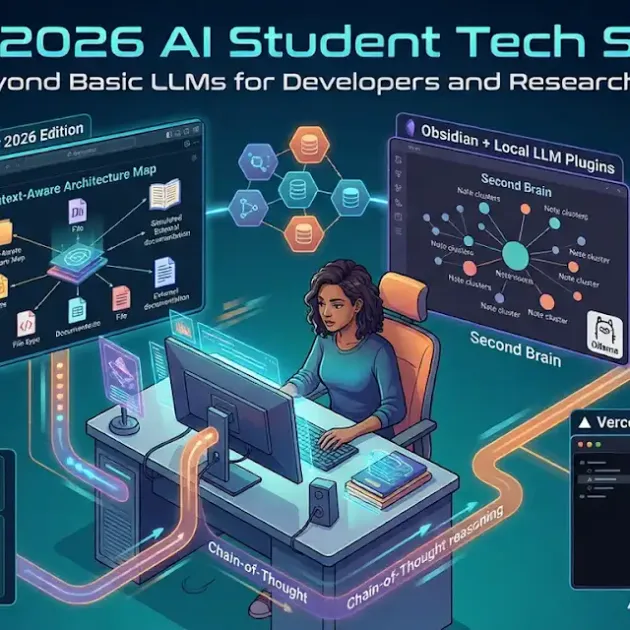
For the student-developer, the IDE is the primary classroom. By 2026, Cursor has solidified its place by moving beyond simple autocompletion to Context-Aware Architecture Mapping.
- Key Feature: The ability to index an entire codebase and external documentation via local embeddings.
- Why it matters: It allows students to learn complex frameworks (like the latest Next.js or Rust paradigms) by asking questions directly against the source code.
- Technical Edge: Utilizes high-context windows (up to 2M tokens) to maintain logical consistency across thousands of files.
2. Research & Synthesis: Perplexity Pro & Elicit
Traditional search is dead. Students in 2026 utilize AI-native research engines that cite peer-reviewed sources with surgical precision.
- Perplexity Pro: Acts as a real-time discovery engine. It uses a multi-agent approach to cross-reference academic journals and live web data.
- Elicit: Essential for graduate students and researchers. It automates literature reviews, extracting data from papers and synthesizing findings into structured technical reports.
3. Personal Knowledge Management (PKM): Obsidian + Local LLM Plugins
Privacy and data sovereignty are paramount in 2026. The most sophisticated students are running local RAG systems over their lecture notes and research papers.
- The Workflow: Using Obsidian integrated with Ollama or LM Studio.
- The Benefit: You can query your entire academic history without your data leaving your machine. This 'Second Brain' becomes a personalized tutor that understands your specific learning curve.
4. Mathematical & Scientific Computation: WolframAlpha + GPT-5 / Claude 4
LLMs have historically struggled with symbolic logic. However, the 2026 ecosystem solves this through API-driven tool use.
- The Integration: Students use specialized agents that delegate complex calculus or physics simulations to the Wolfram Engine while using the LLM for conceptual explanation.
- Use Case: Bridging the gap between high-level theory and precise mathematical proof.
5. Automated DevOps for Students: Vercel v0 & Replit Agent
For startups and student entrepreneurs, the barrier to deployment has vanished.
- Vercel v0: Allows for the generation of complex UI components using simple natural language, optimized for performance and accessibility.
- Replit Agent: Can set up entire backend environments, manage databases, and handle deployment pipelines, allowing students to focus on logic and architecture rather than configuration.
Ethical Engineering and AI Literacy
In 2026, the elite student distinguishes themselves not by using AI to bypass work, but by using it to accelerate comprehension. The focus is on Prompt Engineering 2.0—understanding how to structure multi-step reasoning chains (Chain-of-Thought) and verifying AI outputs against empirical data.
Conclusion
The 2026 AI toolset is about synergy. By combining local inference for privacy, agentic coding tools for speed, and RAG-based research engines for accuracy, the modern student is essentially a 'Full-Stack Researcher.' The competitive advantage lies in mastering the orchestration of these tools.