Can AI Build an Entire App Alone? The State of Autonomous Development in 2026
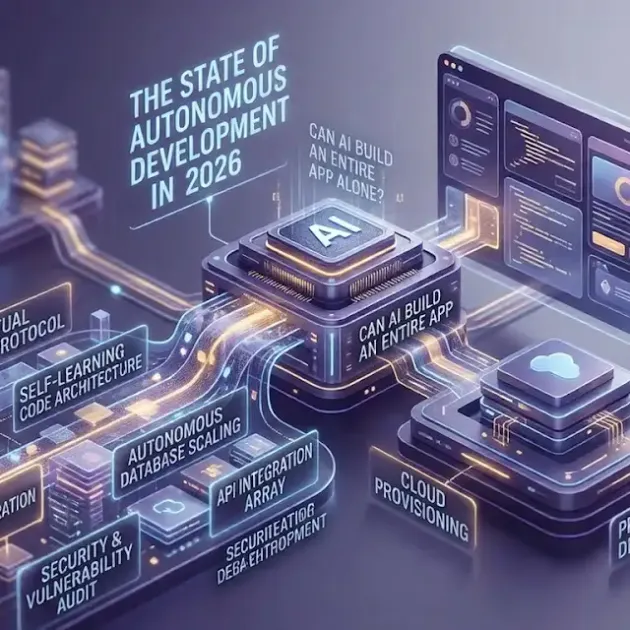
Can AI Build an Entire App Alone? The State of Autonomous Development in 2026
By 2026, the question is no longer whether AI can write code, but whether it can orchestrate the entire lifecycle of software development. We have moved beyond simple autocompletion into the era of Agentic Software Engineering.
The Evolution: From Copilots to Autopilots
In early 2024, tools like GitHub Copilot and Cursor changed how we wrote functions. By 2026, the industry has pivoted toward Autonomous Agents (think successors to Devin and OpenDevin) that don't just suggest lines of code—they manage repositories.
The 2026 Tech Stack for AI Agents
Today’s AI agents leverage a sophisticated stack to build applications:
- Reasoning Engines: Models with 1M+ token contexts that understand the entire codebase.
- Tool Use: Agents that can spin up Docker containers, run test suites, and debug in real-time.
- Self-Correction Loops: If a build fails, the agent analyzes the stack trace and applies a patch without human intervention.
What AI Can Do Alone in 2026
1. Architecture Design and Boilerplating
AI can now ingest a PRD (Product Requirements Document) and output a full system architecture, including database schemas (SQL/NoSQL), API definitions (GraphQL/REST), and microservices infrastructure.
2. Full-Stack Implementation
With multimodal capabilities, AI can take a Figma screenshot and convert it into a responsive Tailwind/React frontend, while simultaneously generating the Node.js or Python backend logic.
3. Automated CI/CD and DevOps
Setting up Kubernetes clusters or AWS Lambda functions is now a natural language task. AI agents monitor deployment logs and automatically rollback if performance metrics dip.
The "Human-in-the-Loop" Reality
Despite the "Alone" in the title, total autonomy remains a nuance. While an AI can build a functional Todo List or SaaS MVP in minutes, complex enterprise systems require human oversight for:
- Strategic Alignment: Does this feature actually solve the user's problem?
- Security Nuance: Identifying zero-day vulnerabilities that the AI hasn't seen in its training data.
- Ethical UX: Ensuring the interface doesn't include dark patterns or accessibility lapses.
The Verdict: Can it build an app alone?
Yes, for 80% of standard use cases. In 2026, a founder can describe a niche marketplace or a productivity tool, and an AI agent will deploy a production-ready version in under an hour. However, for the remaining 20%—the revolutionary, high-scale, or highly regulated apps—AI serves as a high-speed engine, but a human remains at the steering wheel.
Conclusion
The role of the developer has shifted from Syntactician to Architect and Reviewer. Learning to prompt is yesterday's news; learning to orchestrate agents is the skill of 2026.