Freelancing in the Age of AI (2026): The Top High-Value Niches for Remote Tech Pros
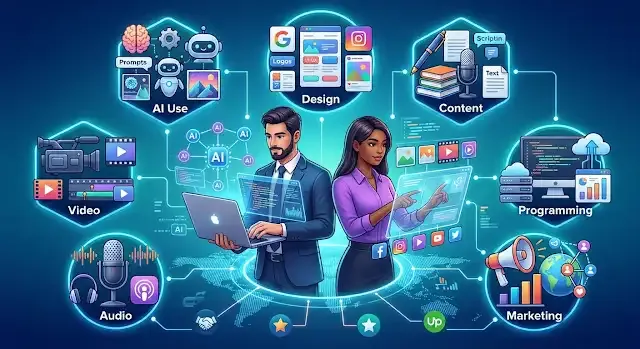
Freelancing in the Age of AI (2026): The Top High-Value Niches for Remote Tech Pros
By 2026, the freelance landscape has undergone a seismic shift. The traditional model of "trading hours for code" is being replaced by an output-driven economy powered by Generative AI and Autonomous Agents. For software developers and tech enthusiasts, the challenge isn't the lack of work, but the evolution of the required skill set.
In this guide, we explore the most lucrative remote-work fields where human expertise and AI orchestration meet.
1. AI Agent Architecture & Multi-Agent Systems
The demand for simple CRUD applications has stabilized, but the hunger for Autonomous AI Agents has exploded. Startups are no longer looking for just a developer; they need an architect who can build systems where AI agents (using frameworks like LangGraph or CrewAI) collaborate to solve complex business logic.
Key Technical Focus:
- Orchestration: Managing state and memory in multi-agent workflows.
- Tool-Use (Function Calling): Teaching models how to interact with external APIs and legacy databases.
- Self-Healing Code: Implementing systems that can debug and patch themselves in real-time.
2. LLMOps and Custom Model Fine-Tuning
Generic GPT models are no longer enough for enterprise-grade security and specificity. Freelancers specializing in LLMOps (Large Language Model Operations) are helping companies deploy small, specialized models (SLMs) on-premise or in private clouds.
Skills in Demand:
- RAG (Retrieval-Augmented Generation): Building advanced vector database pipelines (Pinecone, Weaviate).
- Quantization: Making large models run efficiently on consumer-grade hardware.
- Fine-tuning: Using techniques like LoRA and QLoRA to adapt models to specific industry jargon.
3. AI Safety and Ethical Auditing
As regulation catches up with technology (like the EU AI Act), startups need freelance consultants to ensure their algorithms are unbiased, secure, and compliant. This is a high-barrier-to-entry field that combines legal understanding with deep technical audits.
Core Tasks:
- Adversarial Testing: Stress-testing models against "jailbreaking" and prompt injections.
- Bias Mitigation: Analyzing training data for socio-economic biases.
- Compliance Automation: Developing tools that track AI decision-making for regulatory reports.
4. Technical Content Engineering & AI-Assisted Documentation
The role of the technical writer has evolved into the Content Engineer. Startups need documentation that isn't just readable by humans, but also structured for "AI-Consumption." This ensures that when a user asks an AI assistant about a product, the AI provides accurate, structured answers based on the docs.
- The Strategy: Moving from Markdown to Graph-based documentation structures.
- The Goal: Maximizing the "LLM-Friendliness" of technical repositories.
5. Cybersecurity for the AI Era
AI has democratized hacking. Consequently, the need for AI-driven defense mechanisms is at an all-time high. Freelance cybersecurity experts are now building automated threat-detection systems that use machine learning to identify anomalous patterns in network traffic before a breach occurs.
Conclusion: The Rise of the "Full-Stack AI Orchestrator"
To thrive in 2026, you must stop being a "resource" and start being a "solution architect." The most successful freelancers aren't those who fear AI, but those who use it to deliver 10x the value in 1/10th of the time. Whether you are building agentic workflows or auditing models for bias, the remote work future belongs to those who bridge the gap between human intent and machine execution.