The Future of Cybersecurity: How AI Is Transforming Digital Defense in 2026
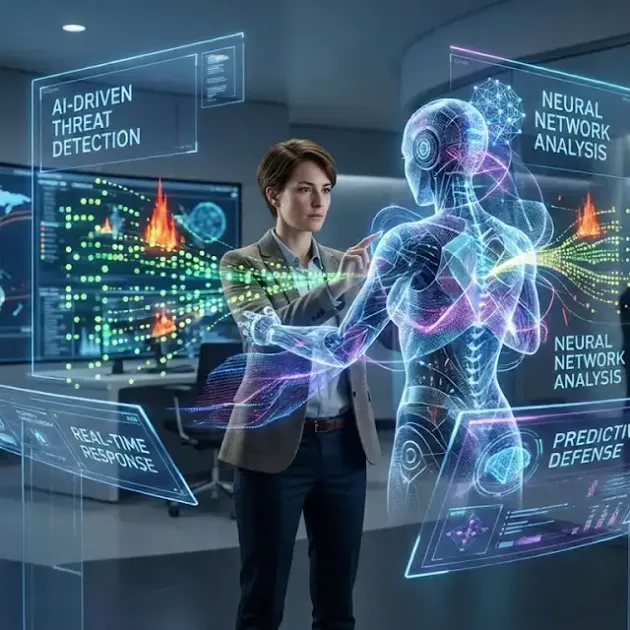
The Future of Cybersecurity: How AI Is Transforming Digital Defense in 2026
As digital ecosystems expand at an unprecedented pace, traditional cybersecurity approaches are no longer sufficient. The era of static perimeter defenses is rapidly giving way to dynamic, autonomous, and AI-driven security systems.
Artificial Intelligence is now playing a critical role in detecting threats, automating security operations, and protecting modern digital infrastructure. For developers, startups, and technology professionals, understanding how AI is transforming cybersecurity is essential to staying ahead of evolving cyber threats.
This article explores how AI is reshaping digital defense and what the future of cybersecurity may look like.
1. From Signature-Based Security to AI Behavioral Analysis
Traditional cybersecurity tools relied heavily on signature-based detection. Security systems scanned files and network traffic for known patterns that matched previously identified malware.
However, modern cyber threats such as polymorphic malware and zero-day attacks can easily bypass these legacy systems.
AI and machine learning are changing this model by focusing on behavioral analysis rather than static signatures.
Anomaly Detection
Machine learning models create a baseline of normal activity within a system. When unusual behavior occurs, the system immediately raises an alert.
For example:
- A user accessing sensitive systems at unusual hours
- Logins from unfamiliar geographic locations
- Abnormal data transfer activity
These anomalies are detected instantly using AI-driven monitoring systems.
Automated Incident Response
Security platforms increasingly rely on Security Orchestration, Automation, and Response (SOAR) systems.
These platforms use AI to automatically:
- Investigate security alerts
- Isolate compromised systems
- Block malicious traffic
- Trigger security response playbooks
Automated response drastically reduces the time needed to contain cyber attacks.
2. AI-Powered DevSecOps: Securing the Development Pipeline
For software developers, one of the most important cybersecurity trends is the integration of AI into DevSecOps workflows.
Maintaining secure code across large and complex codebases is extremely challenging without automation.
AI-powered security tools help developers identify vulnerabilities earlier in the development lifecycle.
Intelligent Code Analysis (SAST & DAST)
Modern AI-driven tools can analyze source code in real time while developers write it.
These tools can detect vulnerabilities such as:
- SQL injection
- Cross-site scripting (XSS)
- Insecure authentication logic
- API security weaknesses
AI models trained on millions of code repositories can significantly reduce false positives, helping developers focus on real security risks.
Predictive Vulnerability Management
AI systems can prioritize vulnerabilities based on:
- Exploit likelihood
- Impact on the application
- Exposure of sensitive data
Some advanced platforms can even automatically recommend or apply security patches, reducing the risk of exploitation.
3. Adversarial AI: When Attackers Use Artificial Intelligence
While defenders are leveraging AI to improve security, cybercriminals are also using AI to launch more sophisticated attacks.
This emerging field is known as Adversarial AI.
AI-Driven Phishing Attacks
Large language models allow attackers to generate highly convincing phishing emails that appear authentic and personalized.
These attacks are harder to detect because they no longer contain obvious spelling or grammatical errors.
Deepfakes and Social Engineering
AI-generated voice and video deepfakes are increasingly being used in social engineering attacks.
Examples include:
- Impersonating executives in phone calls
- Creating fake video messages
- Bypassing biometric authentication systems
These techniques significantly increase the effectiveness of cyber fraud.
4. Zero Trust Security in the AI Era
The Zero Trust security model is becoming the new standard in cybersecurity.
The core principle of Zero Trust is simple:
“Never trust, always verify.”
AI enhances this model by enabling continuous authentication.
Instead of verifying identity only during login, AI continuously analyzes behavioral signals such as:
- Typing patterns
- Mouse movement behavior
- Device fingerprinting
- Location data
If unusual activity is detected, access can be restricted immediately.
5. The Future of AI in Cybersecurity
The role of AI in cybersecurity will continue to grow as cyber threats become more complex.
Future developments may include:
- Fully autonomous security operations centers (SOCs)
- AI-driven threat intelligence platforms
- Self-healing systems capable of automatically repairing vulnerabilities
- Advanced predictive security models that anticipate attacks before they occur
Organizations that adopt AI-driven cybersecurity strategies will be better equipped to defend against next-generation cyber threats.
Conclusion
Artificial Intelligence is redefining how organizations approach cybersecurity.
Instead of relying solely on human analysts and reactive defenses, modern security strategies increasingly depend on AI-powered detection, automation, and predictive analytics.
However, the future of cybersecurity is not about replacing humans with machines. Instead, it is about creating a human–AI partnership where intelligent systems enhance the capabilities of security professionals.
As cyber threats continue to evolve, integrating AI into security infrastructure will become a critical requirement for businesses and technology teams worldwide.
FAQ
How is AI used in cybersecurity?
AI is used to detect threats, analyze network behavior, automate incident response, and identify vulnerabilities in software systems.
Can AI prevent cyber attacks?
AI can significantly reduce the risk of cyber attacks by detecting suspicious behavior and responding faster than traditional security systems.
What is adversarial AI?
Adversarial AI refers to the use of artificial intelligence by attackers to bypass security systems or manipulate AI models.
Why is Zero Trust important in modern cybersecurity?
Zero Trust ensures that every user and device must be verified continuously, reducing the risk of unauthorized access and insider threats.