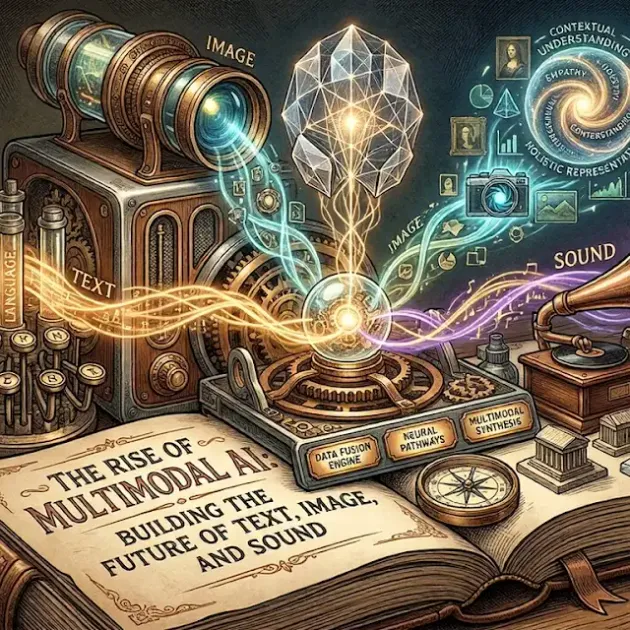
The Rise of Multimodal AI: Building the Future of Text, Image, and Sound
Introduction: Beyond the Text Box
For years, Large Language Models (LLMs) like GPT-3 dominated the conversation, showcasing an uncanny ability to manipulate text. However, human intelligence isn't siloed; we perceive the world through a symphony of senses. The next frontier, Multimodal AI, aims to replicate this by integrating text, images, video, and audio into a single, unified cognitive framework.
For developers and startups, this isn't just a trend—it's a paradigm shift in how we build applications. From healthcare diagnostics to autonomous systems, the ability to process diverse data types simultaneously is the key to unlocking true artificial general intelligence (AGI).
1. What is Multimodal AI?
Multimodal AI refers to machine learning models capable of processing and relating information from multiple sources—or modalities. Unlike unimodal systems (which only handle text or only images), multimodal systems can:
- Generate images from text (e.g., DALL-E 3, Midjourney).
- Explain videos by identifying objects and actions in real-time.
- Transcribe and translate audio while maintaining emotional context.
The Core Architecture: Joint Embeddings
At the heart of these systems is the concept of a Joint Latent Space. Using techniques like Contrastive Learning (e.g., OpenAI's CLIP), models are trained to map different modalities into the same mathematical space. This allows a vector representing the word "golden retriever" to sit numerically close to a vector representing an actual image of that dog.
2. Key Technologies Driving the Revolution
A. Transformers as a Universal Backbone
The Transformer architecture, originally designed for NLP, has proven versatile. By treating image patches or audio frames as "tokens" (similar to words), models like ViT (Vision Transformer) and AudioGPT use the same underlying self-attention mechanisms to find patterns across data types.
B. Large Multimodal Models (LMMs)
Recent releases have set a new gold standard:
- GPT-4o: Natively multimodal, designed for real-time low-latency interaction across voice, text, and vision.
- Gemini 1.5 Pro: Features a massive context window capable of analyzing hours of video or thousands of lines of code alongside images.
- Claude 3: Exceptional at visual reasoning, such as interpreting complex technical diagrams and flowcharts.
3. Real-World Applications for Developers
Healthcare & Biotech
Imagine an AI that reviews a patient’s MRI scan (image), reads their medical history (text), and listens to a recording of their symptoms (audio) to provide a holistic diagnosis. This cross-referencing reduces errors and speeds up clinical workflows.
E-Commerce & Retail
Visual search is becoming the standard. Startups are building tools that allow users to snap a photo of a piece of furniture and find similar items while specifying "I want this, but in a mid-century modern style" (combining image + text query).
Next-Gen Content Creation
AI-powered video editors can now take a raw video file and automatically generate subtitles, background music that matches the mood (audio-to-audio), and social media descriptions, all within one pipeline.
4. Challenges: The Developer’s Hurdle
While promising, building multimodal systems presents unique challenges:
- Data Alignment: Finding datasets where text, audio, and video are perfectly synced is difficult.
- Computational Cost: Training and deploying these models require significant GPU resources (H100s/A100s).
- Latency: Real-time multimodal interaction (like a voice assistant) requires incredibly fast inference to feel natural.
Conclusion: The Era of Context-Aware Software
We are moving away from software that simply executes commands toward software that understands context. For startups, the opportunity lies in fine-tuning these massive multimodal models for niche industries. The winner of the next tech decade won't just build the smartest chatbot, but the most perceptive entity—one that can see, hear, and speak with the world just as we do.