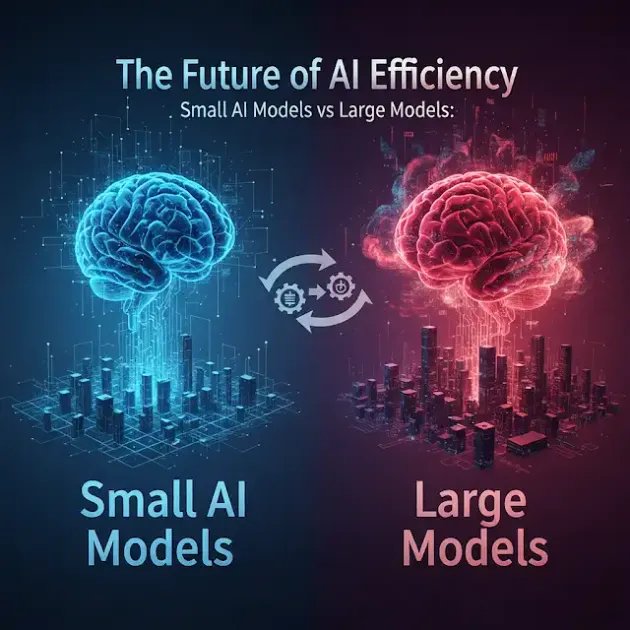
Small AI Models vs Large Models: The Future of AI Efficiency
Introduction: The Paradigm Shift in Artificial Intelligence
For the past few years, the AI narrative has been dominated by a singular mantra: Bigger is Better. From GPT-3 to GPT-4 and Gemini Ultra, the industry has chased trillion-parameter counts to achieve emergent capabilities. However, a silent revolution is brewing. As developers and startups face high API costs and latency issues, the industry is pivoting toward Small Language Models (SLMs).
In this guide, we explore the technical nuances between Large Language Models (LLMs) and Small AI Models, analyzing why the future of AI efficiency might actually be small.
1. Understanding Large Language Models (LLMs)
LLMs are typically defined by their massive parameter counts (ranging from 70B to 1.8T+). They are trained on vast datasets encompassing the entire public internet, allowing them to exhibit remarkable reasoning and creative abilities.
The Strengths of LLMs
- Emergent Reasoning: Large models can solve complex problems they weren't explicitly trained for.
- Generalization: They act as a 'Swiss Army Knife' for various tasks (coding, translation, creative writing).
- Few-Shot Learning: They require minimal examples to understand a new task.
The Challenges
- Prohibitive Costs: Training and running these models requires thousands of H100 GPUs.
- Latency: Inference times are often too slow for real-time applications.
- Privacy Concerns: Sending sensitive data to external APIs is a dealbreaker for many enterprises.
2. The Rise of Small Language Models (SLMs)
Small AI models (typically 1B to 10B parameters) like Microsoft's Phi-3, Mistral 7B, and Llama 3 8B are proving that size isn't everything. These models are designed to be lean, fast, and highly specialized.
How They Achieve Efficiency
- Knowledge Distillation: A process where a 'teacher' LLM trains a 'student' SLM to mimic its behavior.
- Quantization: Reducing the precision of model weights (from FP16 to INT8 or INT4) to lower memory usage.
- High-Quality Data: Instead of crawling the whole web, SLMs are trained on curated, high-quality textbooks and logic-rich data.
3. Technical Comparison: LLMs vs. SLMs
| Feature | Large Models (LLMs) | Small Models (SLMs) |
|---|---|---|
| Parameters | 70B - 1.8T+ | 1B - 10B |
| Infrastructure | Multi-GPU Clusters | Single GPU or Edge Devices |
| Fine-tuning | Extremely Expensive | Cost-effective (LoRA/QLoRA) |
| Deployment | Cloud-only | On-premise / On-device |
| Latency | High | Low (Real-time) |
4. Why Developers and Startups are Switching
Privacy and On-Device AI
With SLMs, developers can run AI locally on smartphones or private servers. This ensures that user data never leaves the device, making it ideal for healthcare and legal sectors.
Vertical Specialization
A general-purpose LLM knows everything but is a master of none. A small model fine-tuned on medical journals or proprietary codebases can outperform a giant model in that specific niche while using 1/100th of the resources.
The Cost Factor
Running a startup on GPT-4 APIs can lead to astronomical monthly bills. SLMs allow companies to own their infrastructure, leading to predictable and significantly lower operational costs.
5. The Future: Hybrid AI and MoE
The industry is moving toward a Mixture of Experts (MoE) architecture and hybrid systems. In this setup, a small, efficient model handles simple queries, and only the most complex tasks are 'escalated' to a larger model. This optimizes both performance and cost.
Conclusion: Choosing the Right Model
If you are building a generic chatbot for creative writing, an LLM is your best bet. However, if you are a developer looking to build a fast, private, and cost-effective application—or a startup aiming for vertical mastery—Small AI Models are the future. Efficiency is no longer just a luxury; it is the prerequisite for the next generation of AI innovation.