Weaponizing Intelligence: How Modern Hackers Leverage AI to Exploit Systems
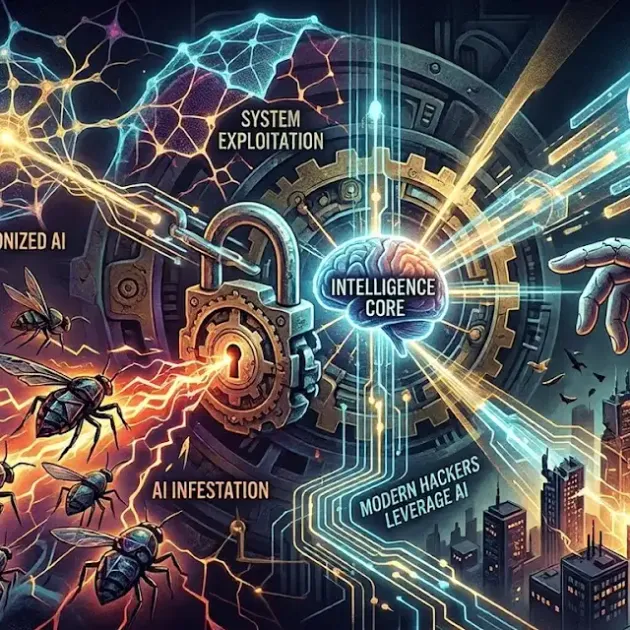
Weaponizing Intelligence: How Modern Hackers Leverage AI to Exploit Systems
In the current cybersecurity landscape, the advent of Large Language Models (LLMs) and Generative AI has provided a double-edged sword. While developers use AI to write cleaner code, threat actors are leveraging these same technologies to automate, scale, and refine their attacks. For software developers and startups, understanding the AI-driven threat matrix is no longer optional—it is a foundational requirement for building resilient systems.
1. Hyper-Personalized Social Engineering
Traditional phishing was often easy to spot due to poor grammar or generic templates. AI has eliminated these "tells."
- LLM-Powered Phishing: Hackers use models to generate perfectly articulated emails, tailored to a target's professional background sourced from LinkedIn or GitHub.
- Deepfake Audio/Video: By training on just a few minutes of public audio, attackers can impersonate a CEO or a technical lead in "vishing" (voice phishing) attacks to authorize fraudulent wire transfers or credential resets.
2. Automated Vulnerability Research (AVR)
Before AI, finding zero-day vulnerabilities required deep manual analysis. Now, AI models can scan massive codebases in seconds.
The Shift to AI-Driven Scanning
Attackers utilize custom-trained models to identify patterns in binary code or open-source repositories that suggest buffer overflows, SQL injection points, or insecure API endpoints. By the time a developer pushes a commit, an automated bot may have already identified a potential exploit path.
3. Adversarial Machine Learning & Evasion
Perhaps the most sophisticated use of AI is attacking other AI systems.
- Data Poisoning: If a startup uses a machine learning model for fraud detection, hackers may attempt to "poison" the training data with subtle anomalies, eventually training the model to ignore specific types of malicious activity.
- Evasion Attacks: Hackers use GANs (Generative Adversarial Networks) to create malware variants that are functionally identical to the original but appear "clean" to AI-based antivirus and EDR (Endpoint Detection and Response) tools.
4. AI-Enhanced Password Cracking and CAPTCHA Solving
AI has rendered traditional "brute force" methods obsolete by introducing smart-guessing algorithms.
- Neural Network Guessing: Tools like PassGAN use deep learning to analyze leaked password databases and predict new passwords with significantly higher accuracy than standard dictionary attacks.
- Vision Models for CAPTCHA: Sophisticated computer vision models can now solve complex CAPTCHAs with higher accuracy and speed than humans, facilitating large-scale bot attacks on login forms.
5. Polymorphic and Metamorphic Malware
AI allows for the creation of Polymorphic Malware—code that constantly rewrites its own signature. Because the AI can generate infinite variations of the code's structure while maintaining its payload, traditional signature-based detection is rendered ineffective.
How Developers Can Fight Back
To counter AI-driven threats, startups and developers must adopt an AI-first defense strategy:
- AI-Driven Code Reviews: Use tools like Snyk or GitHub Advanced Security that utilize AI to find vulnerabilities before they reach production.
- Zero Trust Architecture: Assume that credentials can be compromised via AI-phishing and enforce strict identity verification.
- Anomalous Behavior Monitoring: Instead of looking for known malware signatures, focus on behavioral analysis to detect unusual data egress or API calls.
Conclusion
The weaponization of AI by hackers represents a paradigm shift in digital warfare. As an elite developer or a growing startup, your defense must be as intelligent as the attacks you face. By understanding how AI is used against systems, you can build more robust, self-healing architectures that withstand the next generation of cyber threats.