What Are AI Agents? The Future of Autonomous AI in 2026
What Are AI Agents? The Future of Autonomous AI in 2026
For the past two years, the world has been mesmerized by Generative AI. We marveled at LLMs that could write code, draft emails, and generate images. However, as we approach 2026, the industry is shifting from passive models to Autonomous AI Agents.
But what exactly are AI Agents, and why are they being hailed as the next frontier for software developers and startups? In this guide, we dive deep into the architecture, the shift to agentic workflows, and how these entities will redefine the digital economy.
1. Defining the AI Agent: Moving Beyond the Chatbot
A traditional chatbot like ChatGPT is reactive. It waits for a prompt and provides a response. An AI Agent, conversely, is proactive. It is a system capable of perceiving its environment, reasoning about tasks, and taking actions to achieve a specific goal without constant human intervention.
The Core Components of an AI Agent
To understand an agent, we must look at its cognitive architecture:
- The Brain (LLM/LMM): The reasoning engine that processes information and makes decisions.
- Planning: The ability to break down complex goals into smaller, executable steps (Chain of Thought, Tree of Thoughts).
- Memory: Utilizing Vector Databases (Short-term/Working memory) and RAG (Long-term memory) to retain context and learn from past interactions.
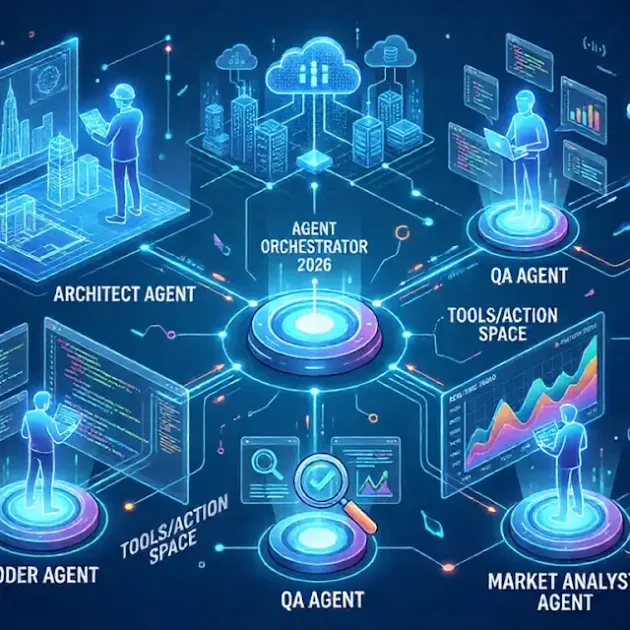
- Tools/Action Space: The ability to call APIs, write and execute code, browse the web, or interact with external software suites.
2. From Copilots to Autopilots: The 2026 Paradigm
In 2024, we used "Copilots" to assist our work. By 2026, the standard will be "Autopilots"—multi-agent systems that work in orchestration.
The Shift to Agentic Workflows
Instead of a single prompt-response loop, Agentic Workflows involve an iterative process where the agent:
- Drafts a solution.
- Self-Critiques or tests the solution.
- Refines the output based on errors.
- Finalizes the task.
Technical leaders are moving away from "Zero-Shot" prompting toward these iterative loops, which significantly increase the success rates of complex tasks like software debugging and market analysis.
3. Technical Architecture: How AI Agents Function
For developers, building an agent requires more than just an API key. It involves sophisticated orchestration layers:
A. Reasoning Frameworks (ReAct, Reflexion)
The ReAct (Reason + Act) framework allows agents to verbalize their thought process before executing a tool call. This transparency is vital for debugging and ensuring the agent is on the right track.
B. The Multi-Agent Orchestration (MAO)
Why have one agent when you can have a department? In 2026, we will see specialized agent clusters:
- The Architect Agent: Defines the structure.
- The Coder Agent: Writes the implementation.
- The QA Agent: Tests and provides feedback.
Frameworks like Microsoft AutoGen, LangGraph, and CrewAI are already paving the way for this collaborative intelligence.
4. Use Cases for Startups and Developers
- Autonomous DevOps: Agents that monitor server logs, identify bottlenecks, and automatically deploy patches.
- Personalized Growth Hackers: Agents that analyze real-time market trends, A/B test ad copy, and adjust bidding strategies autonomously.
- Hyper-Personalized Support: Moving beyond FAQ bots to agents that can access a user's account (with permission), diagnose a technical issue, and resolve it within the database.
5. Challenges: The Roadblocks to Full Autonomy
Despite the promise, several hurdles remain for 2026:
- Reliability & Hallucinations: An autonomous agent making a mistake in a production database can be catastrophic.
- Security (Prompt Injection): Protecting agents from malicious instructions hidden in external data.
- Cost of Inference: Running iterative agentic loops requires significant compute power.
Conclusion: Preparing for the Agentic Era
The transition to AI Agents represents a fundamental shift in how we build software. We are moving from building tools for humans to building environments for agents. For developers and startups, the opportunity lies in mastering orchestration, ensuring data privacy, and designing robust "guardrails" for these autonomous entities.
As we look toward 2026, the question isn't whether you will use AI, but how many agents will be working for you.