AI Cybersecurity Tools Every Company Should Know in 2026: A Technical Deep Dive
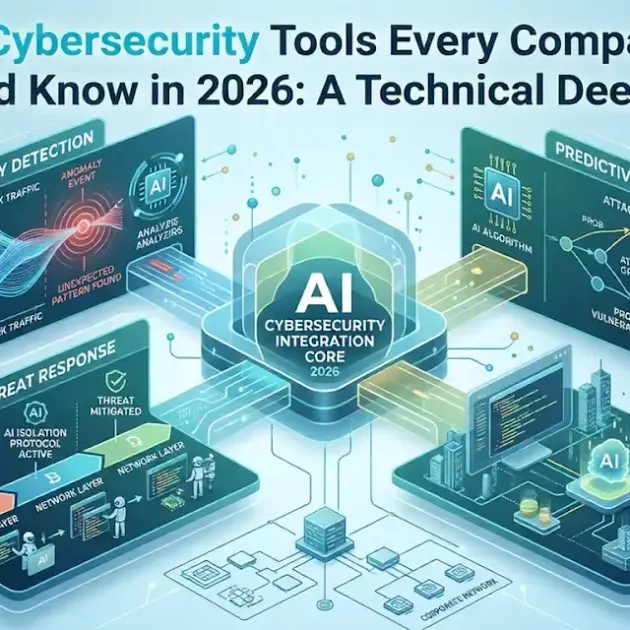
The New Frontier: Why 2026 is the Year of Autonomous Security
As we enter 2026, the cybersecurity landscape has shifted from a battle of humans against machines to a war of AI vs. AI. For software developers and startups, traditional firewalls and signature-based antivirus are no longer sufficient. Modern threats now involve polymorphic malware and automated social engineering that evolve in real-time.
To stay resilient, companies must integrate AI-native security tools that move beyond detection into the realm of prediction and autonomous remediation. This guide explores the essential categories and tools that define the 2026 security stack.
1. AI-Powered XDR (Extended Detection and Response)
In 2026, Extended Detection and Response (XDR) has evolved into a fully autonomous system. Unlike traditional EDR, AI-powered XDR correlates telemetry across email, endpoints, servers, cloud workloads, and networks to identify complex attack patterns.
- Key Capability: Behavioral baselining using Deep Learning.
- Featured Tooling: CrowdStrike Falcon Next-Gen and SentinelOne Singularity. These platforms now utilize generative AI to explain complex threats to junior developers in plain English while executing automated isolation of compromised nodes.
2. Securing the LLM Pipeline: AI-Firewalls
With most startups now integrating Large Language Models (LLMs) into their products, the attack surface has expanded to include Prompt Injection and Data Poisoning.
Protecting Your AI Models
- HiddenLayer: An industry leader in protecting the machine learning model integrity. It detects when an attacker is trying to "reverse engineer" your proprietary weights or inject malicious training data.
- Protect AI: Specifically designed for developers, it scans notebooks and pipelines for vulnerabilities in the ML lifecycle.
3. Autonomous Penetration Testing
Why wait for a quarterly manual audit? In 2026, continuous security is the standard. AI-driven pentesting tools simulate sophisticated hackers to find vulnerabilities before they are exploited.
- Horizon3.ai (NodeZero): This tool provides an autonomous pentesting platform that identifies exploitable attack paths. For startups, it’s like having a 24/7 Red Team that scales with your infrastructure.
- Pentera: Uses AI to emulate the entire kill chain, providing a real-time view of your security posture across on-prem and cloud environments.
4. AI-Driven Identity and Access Management (IAM)
Identity is the new perimeter. In 2026, static passwords are dead. AI-driven IAM tools analyze the context of every login attempt.
- Okta AI / Microsoft Entra ID: These platforms now use Risk-Based Authentication (RBA). If a developer logs in from an unusual location and immediately tries to access a sensitive S3 bucket, the AI triggers an immediate biometric re-verification or blocks the session entirely based on behavioral anomalies.
5. Automated Code Security (DevSecOps)
For software developers, the "Shift Left" movement is now powered by Generative AI.
- Snyk DeepCode: Using a proprietary AI engine, Snyk goes beyond pattern matching. It understands the logic of your code, identifying semantic vulnerabilities that traditional AST (Application Security Testing) tools miss.
- GitHub Advanced Security: Leveraging the power of Copilot, it provides real-time remediation suggestions, allowing developers to fix vulnerabilities with a single click during the PR process.
Summary for Startups: How to Build Your 2026 Security Roadmap
- Prioritize Visibility: Implement an AI-XDR to see across your entire stack.
- Secure Your AI: If you use LLMs, implement a dedicated AI-Firewall.
- Automate Compliance: Use AI tools to map your security posture to frameworks like SOC2 or ISO 27001 automatically.
Conclusion: In 2026, the question isn't if you will be targeted, but how fast your AI can respond. Investing in these tools today isn't just about security—it's about ensuring your startup's longevity in an increasingly automated digital economy.