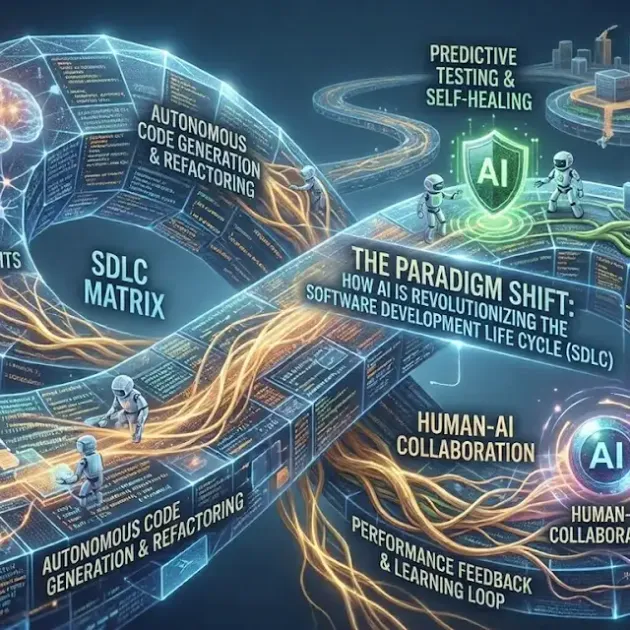
The Paradigm Shift: How AI is Revolutionizing the Software Development Life Cycle (SDLC)
Introduction
The landscape of software engineering is undergoing its most significant transformation since the invention of the high-level programming language. Artificial Intelligence (AI) is no longer a futuristic concept—it is a core component of the modern developer's toolkit. From Large Language Models (LLMs) like GPT-4 and Claude to specialized tools like GitHub Copilot, AI is fundamentally altering how code is written, tested, and deployed.
1. AI-Powered Pair Programming and Code Generation
The most visible impact of AI is in code generation. Tools integrated directly into the IDE (Integrated Development Environment) now provide context-aware suggestions, significantly reducing the cognitive load on developers.
- Contextual Autocomplete: Modern AI tools don't just suggest the next word; they understand the entire codebase through Retrieval-Augmented Generation (RAG), providing full function implementations that adhere to existing patterns.
- Boilerplate Elimination: AI excels at generating repetitive code (CRUD operations, API boilerplate), allowing developers to focus on high-level architecture and complex logic.
2. Transforming Quality Assurance and Debugging
Testing has historically been the bottleneck of the SDLC. AI is changing this by automating the creation of comprehensive test suites.
Automated Unit Testing
AI can analyze a function and automatically generate edge-case unit tests that a human might overlook. This ensures higher code coverage and more resilient software.
Predictive Debugging
Advanced AI models can now scan codebases to identify potential security vulnerabilities or logic flaws before the code is even compiled. By training on millions of open-source commits, these models recognize "smelly" code and suggest proactive refactoring.
3. The Rise of AIOps and Intelligent DevOps
Beyond the code editor, AI is streamlining DevOps and infrastructure management.
- Infrastructure as Code (IaC): AI can generate Terraform or CloudFormation scripts based on natural language descriptions of the required architecture.
- Anomaly Detection: AI-driven monitoring tools can distinguish between normal traffic spikes and malicious DDoS attacks or system failures, triggering automated scaling or self-healing protocols.
4. The Changing Role of the Developer
As AI takes over the "syntax management," the developer's role is shifting toward that of a System Architect and Product Owner.
- Orchestration over Implementation: Developers spend more time defining requirements and verifying AI outputs than typing line-by-line code.
- Prompt Engineering for Coders: Knowing how to frame a problem to an LLM is becoming a vital technical skill.
- Ethical Oversight: Developers must now act as the final gatekeepers for security, licensing, and ethical biases in AI-generated code.
Conclusion
AI is not replacing software developers; it is empowering them to build more complex, secure, and efficient systems at an unprecedented pace. Startups and established enterprises that embrace AI-Augmented Development will gain a significant competitive advantage in the digital-first economy.