The Future of No-Code AI Development: Bridging the Gap Between Concept and Scale
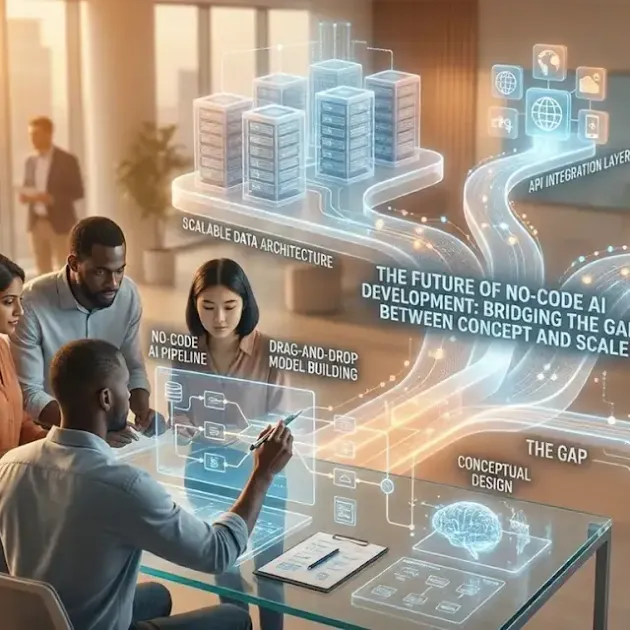
The Future of No-Code AI Development: Bridging the Gap Between Concept and Scale
In the traditional software lifecycle, the barrier to entry for integrating Artificial Intelligence (AI) has always been steep. From mathematical modeling to data engineering and infrastructure management, the requirements often sidelined startups and non-technical founders. However, we are entering a new era. The rise of No-Code AI Development is not just a trend; it is a fundamental shift in how software is architected and deployed.
1. The Evolution: From Static Templates to Generative Intelligence
No-Code started as a way to build simple websites and CRUD applications. Today, it has evolved into a sophisticated ecosystem capable of handling complex Machine Learning (ML) workflows. The integration of Large Language Models (LLMs) via APIs (like OpenAI’s GPT-4 or Anthropic’s Claude) has transformed No-Code platforms from simple logic builders into Cognitive Engines.
Key Technological Drivers:
- Natural Language Programming: Developers and founders can now describe logic in plain English, which the platform translates into executable code or workflow nodes.
- AutoML Integration: Platforms are automating hyperparameter tuning and model selection, allowing users to build predictive models without a Ph.D. in Data Science.
- Pre-built Neural Blocks: Modular blocks for sentiment analysis, image recognition, and predictive analytics are becoming standard in tools like Bubble, FlutterFlow, and Zapier.
2. Why Developers Should Care: The Rise of the "Orchestrator"
A common misconception is that No-Code replaces developers. In reality, it evolves their role. Senior engineers are moving from writing repetitive boilerplate code to becoming System Orchestrators.
- Rapid Prototyping: Validating a product-market fit (PMF) in days rather than months.
- Hybrid Architectures: Using No-Code for the frontend and business logic while keeping the core, proprietary algorithms in a custom-coded backend (the "Low-Code/No-Code Hybrid" model).
- Focus on Logic, Not Syntax: Developers can focus on the high-level architecture and security of the application instead of debugging syntax errors.
3. Critical Challenges: The Hurdles Ahead
Despite the optimism, the future of No-Code AI must address several technical bottlenecks:
- Scalability & Performance: High-frequency trading or massive data processing still requires the optimization of native code (C++, Rust).
- Security & Compliance: Data privacy (GDPR/CCPA) remains a concern when data passes through third-party No-Code providers.
- Vendor Lock-in: The difficulty of migrating complex logic from one platform to another is a significant risk for enterprise-grade applications.
4. The Horizon: Specialized AI Agents
The next five years will see a shift toward Autonomous No-Code Agents. These agents won't just follow instructions; they will monitor data, identify inefficiencies, and suggest (or implement) improvements to the application autonomously. We are moving toward a world of Self-Healing Software.
Conclusion
The future of No-Code AI Development is defined by democratization without compromise. For startups, it means a faster time-to-market. For developers, it means a more powerful toolkit to build complex systems. As these platforms become more robust, the line between "coder" and "creator" will continue to blur, ushering in a decade of unprecedented digital innovation.