The Silent Revolution: Why Local AI Devices Will Transform the Future of Computing
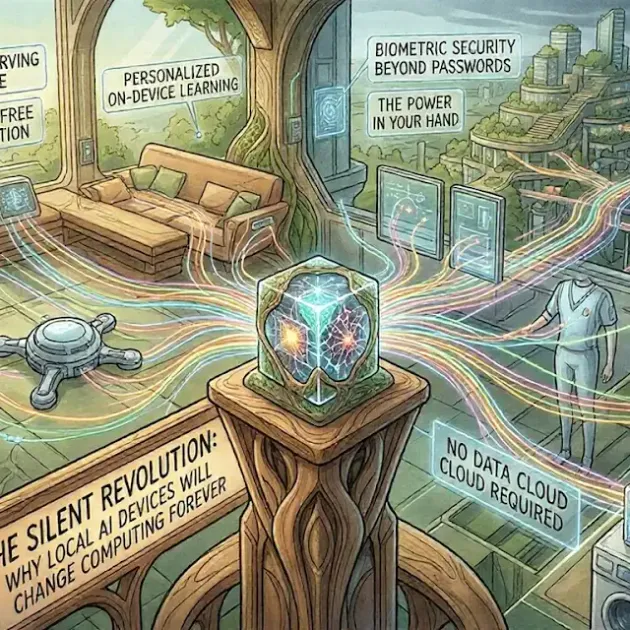
The Silent Revolution: Why Local AI Devices Will Transform the Future of Computing
For more than a decade, the technology industry has focused heavily on cloud computing. The dominant narrative suggested that powerful data centers and thin client devices would define the future of software.
However, the rise of Large Language Models (LLMs) and generative AI is changing this assumption. A major shift is now underway: AI inference is moving from the cloud to local devices.
Local AI—running directly on laptops, smartphones, and edge devices—is emerging as a new computing paradigm that offers faster performance, improved privacy, and lower operational costs.
This shift may fundamentally reshape how developers build applications and how users interact with intelligent systems.
1. Eliminating Latency: Real-Time AI Interaction
Cloud-based AI systems require sending requests to remote servers where GPUs process the workload before returning a response.
This process introduces unavoidable latency caused by network delays.
Local AI removes this limitation by running inference directly on the user's device.
Instant Response Times
When a Neural Processing Unit (NPU) processes AI tasks locally, the system can deliver responses almost instantly.
Examples include:
- Real-time code generation and auto-completion
- Live translation in messaging applications
- Voice assistants with immediate responses
- AI-powered user interfaces that react instantly
This level of responsiveness enables a much more natural human–computer interaction.
Offline AI Capabilities
Another key advantage of local AI systems is their ability to operate without an internet connection.
Applications powered by on-device AI can function:
- in remote areas
- on airplanes
- inside secure enterprise environments
This opens new possibilities for offline-first software applications.
2. Privacy and Data Sovereignty
One of the biggest concerns with cloud-based AI services is data privacy.
When users send prompts or documents to remote AI providers, sensitive information may leave their control.
Local AI devices offer a privacy-first architecture.
Zero Data Exposure
With on-device AI processing:
- personal data never leaves the device
- confidential files remain local
- sensitive enterprise information is protected
This significantly reduces the risk of data leaks.
Regulatory Compliance
Local AI computing also simplifies compliance with data protection regulations such as:
- GDPR in Europe
- HIPAA for healthcare systems
- data residency laws in multiple jurisdictions
Organizations can process sensitive data without transferring it to external servers.
3. The Hardware Revolution: NPUs and AI Chips
The shift toward local AI is driving a major transformation in computer hardware.
Modern processors increasingly include dedicated AI acceleration units known as Neural Processing Units (NPUs).
Major chip manufacturers are investing heavily in this technology.
Examples include:
- Intel Core Ultra processors with built-in AI acceleration
- AMD Ryzen AI chips
- Apple M-series processors with integrated Neural Engines
Why NPUs Are Important
Unlike traditional CPUs or GPUs, NPUs are specifically designed for the mathematical operations used in neural networks.
This provides several advantages:
- dramatically improved energy efficiency
- faster on-device AI inference
- longer battery life for AI-powered applications
Modern NPUs also support model quantization techniques that allow large AI models to run efficiently on consumer devices.
4. The Economic Shift: From Cloud AI to Local AI
Cloud AI services typically operate on a usage-based pricing model, where companies pay for every API request or token processed.
For startups and developers, these costs can grow quickly.
Local AI introduces a different economic model.
Hardware-Owned AI Inference
When AI runs locally:
- the compute cost is paid once through hardware
- inference costs drop dramatically
- applications become more scalable
This allows startups to build edge-first applications where user devices handle much of the computation.
5. What Developers Need to Learn
The rise of local AI will significantly change the development workflow.
Developers will need to understand new concepts related to on-device AI optimization.
Model Quantization
Quantization techniques compress AI models to make them smaller and faster.
Examples include:
- FP16 models
- INT8 quantization
- 4-bit quantization
These techniques allow large models to run on devices with limited memory.
AI Deployment Frameworks
Developers working with local AI should become familiar with modern inference frameworks such as:
- ONNX Runtime
- Apple CoreML
- Intel OpenVINO
These tools help optimize and deploy AI models efficiently on local hardware.
Choosing Efficient AI Models
Running AI locally requires selecting models optimized for efficiency rather than sheer size.
Examples of efficient open-source models include:
- Mistral 7B
- Phi-3
- Llama 3 (8B)
These models can deliver strong performance while remaining small enough to run on consumer hardware.
The Future of Local AI Computing
Local AI devices represent a major transformation in the computing landscape.
Instead of relying entirely on centralized cloud infrastructure, the future will likely combine:
- powerful cloud-based AI systems
- distributed edge computing
- intelligent local devices
This hybrid architecture will enable faster, more private, and more resilient AI-powered applications.
Conclusion
Local AI devices are not simply a faster alternative to cloud-based AI. They represent a fundamental shift in the architecture of modern computing.
By enabling real-time performance, stronger privacy protection, and lower operational costs, on-device AI is shaping the next generation of digital systems.
For developers, startups, and technology innovators, the opportunity lies in building the local-first AI ecosystem that will define the future of intelligent computing.
FAQ
What is Local AI?
Local AI refers to artificial intelligence models that run directly on user devices such as laptops, smartphones, or edge hardware instead of cloud servers.
What is an NPU?
A Neural Processing Unit (NPU) is a specialized processor designed to accelerate machine learning and AI workloads efficiently.
Why is Local AI important?
Local AI reduces latency, improves privacy, and enables applications to run offline without relying on internet connectivity.
Will Local AI replace cloud AI?
Most experts expect a hybrid model where both cloud AI and local AI devices work together depending on the application.